

Trump’s Tariffs: The Return of Protectionism?
by Giulia Chiesa
Trump’s Tariffs: The Return of Protectionism?
Tariffs are nowadays at the centre of the news all over the world. Since his first mandate, Trump has begun an approach based on tariffs in order to protect national industries, to negotiate with other countries and to realise his so-called “American First” motto. How about other countries’ response? Is it really worth it?
1. Introduction and Context
One of the most frequently used words by Donald Trump is probably “tarrifs”. We often hear about this topic, because it is raising lots of concerns both under economic and political views. But why has he introduced so many tariffs?
Trump used tariffs to protect the American economy and to reshape commercial relationships between other states, from China to European countries.
This is also in line with his political agenda, also known as “America First”, which aims to reduce the trade deficit, to maintain internal support and to protect national industries. (J.P. Morgan )
In addition, tariffs have also been used as a bargaining tool, convincing other countries to make concessions to the US. (Research Center for Security and Geopolitical Studies, 2025)
In the following paragraph, the article will analyse firstly the concept and the relevance of tariffs, then how Trump used them during his first mandate and also in his second one, finally the consequences and the potential risks in the future.
2. The Concept of Tariffs
A tariff is a tax imposed on goods imported into a country. There are two types of tariffs, depending on how they are calculated, as a percentage of the product’s value
or as a fixed amount per unit.
Tariffs are applied mainly to raise the price of foreign goods in order to make domestic products more competitive and to generate more revenue for the State. As a consequence, imported goods become more expensive for the sellers and especially for consumers who tend to buy national products, in this way reducing demand for foreign products.
From an economic point of view, tariffs work as trade barriers, since they protect domestic goods from foreign ones. However they can put more risks and costs on the sellers and on consumers. (Pagella Politica, 2025)
3. Tariffs in Trump’s First Mandate (2017–2021)
Since his first mandate, Trump has used tariffs as a powerful tool. Starting by imposing them on Chinese goods in 2018.
However, he introduced tariffs also against traditional allies such as Canada and the European Union, especially on goods such as steel and aluminum.
Then, several tariffs were applied to an exorbitant number of products, including more than 380 billion dollars of global trade. In this way, the US faced the most protectionist period of its history.
The scope of these measures was to reduce trade deficit, incentivise domestic production and to protect American industries. On the other hand, some countries, especially China, also started to introduce other tariffs to respond.
This created tensions between states and many other economic effects, which are still ambiguous. In fact, in a way protectionist measures effectively protect some sectors, however others have been harmed due to higher costs and reduced exports. (E. Teekan, Encyclopedia Britannica)
4. Tariffs in Trump’s Second Mandate (2025-)
In 2025, with his second election, Trump began a new phase in tariffs policy, introducing a more systematic approach and less specific approach. In fact tariffs are applied to most of the imported products and, in addition to this, higher tariffs on products made in countries with a consistent surplus with the United States. This resulted in more tensions with almost every country globally.
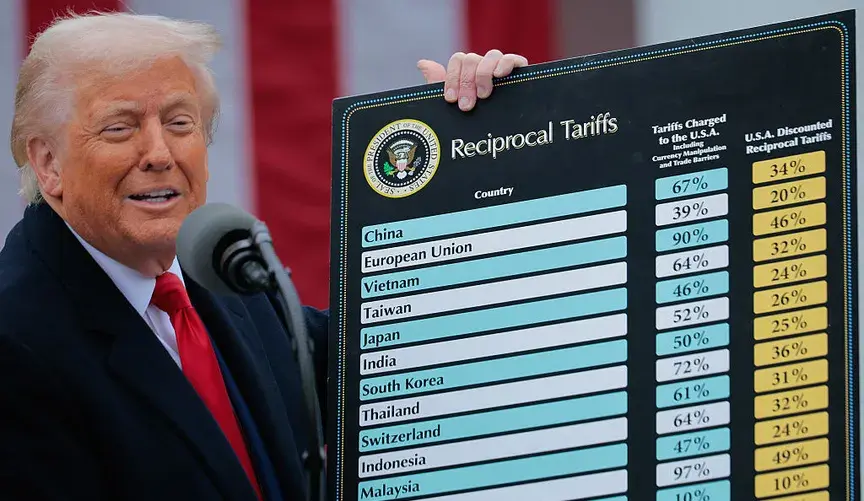
This culminated in April 2025 in the so-called “Liberation Day”, in which Trump's administration introduced a minimum 10% tariff on most imports and to some countries considered responsible for unfair trade practices, higher tariffs were imposed.
This new approach demonstrates how tariffs are used not only to protect the domestic economy, but also as a tool to negotiate with other nations.
However, this strategy is not stable, but tariffs are often changed based on the negotiations between US and other States, causing uncertainty. This raises tensions in trade relationships, concerning especially consumers. (BBC, 2026)
5. Conclusion: Consequences and Potential Risks
The consequences of these tariffs are stil unclear, since they are complex and many aspects need to be considered. It is certainly true that tariffs have provided a certain level of protection to domestic industries, especially concerning steel and manufacturing domestic industries. However, they have increased costs for those businesses that mostly rely on imported goods and to increase prices, damaging consumers. (E. York, 2025)
Moreover, retaliatory tariffs imposed by countries such as China and the European Union have negatively affected U.S. exports, especially in agriculture, forcing the government to introduce financial support measures for affected sectors. (E. Teekah, Encyclopedia Britannica)
At a global level, these policies have contributed to increased uncertainty and tensions in international trade, raising concerns about long-term economic stability and the risk of a broader trade conflict.
In addition, recently, many American companies are starting to bring tariffs to court, arguing that they were unlawfully imposed and caused significant financial losses. In some cases, companies have also asked for refunds or compensation for the duties paid, showing how these measures are controversial.
Bibliography
J.P. Morgan. (2026). US tariffs: What’s the impact?https://www.jpmorgan.com/insights/global-research/current-events/us-tariffs
BBC News. (2026). Trump tariffs: What they mean for global trade.https://www.bbc.com/news/articles/cn93e12rypgo
Research Center for Security and Geopolitical Studies. (2025). The impact of Donald Trump’s tariffs on global trade and the U.S. economy.https://www.rcsgs.org/publications/blog/the-impact-of-donald-trump-s-tariffs-on-global-trade-and-the-u-s-economy
Pagella Politica. (2025). La storia dei dazi di Trump negli Stati Uniti.https://pagellapolitica.it/articoli/storia-dazi-trump-stati-uniti
Encyclopaedia Britannica. (n.d.). Tariff.https://www.britannica.com/money/tariff
Washington International Trade Association (WITA). (n.d.). Tracking the impact of Trump’s tariffs.https://www.wita.org/atp-research/tracking-impact-trump-tariffs/


Commenti